
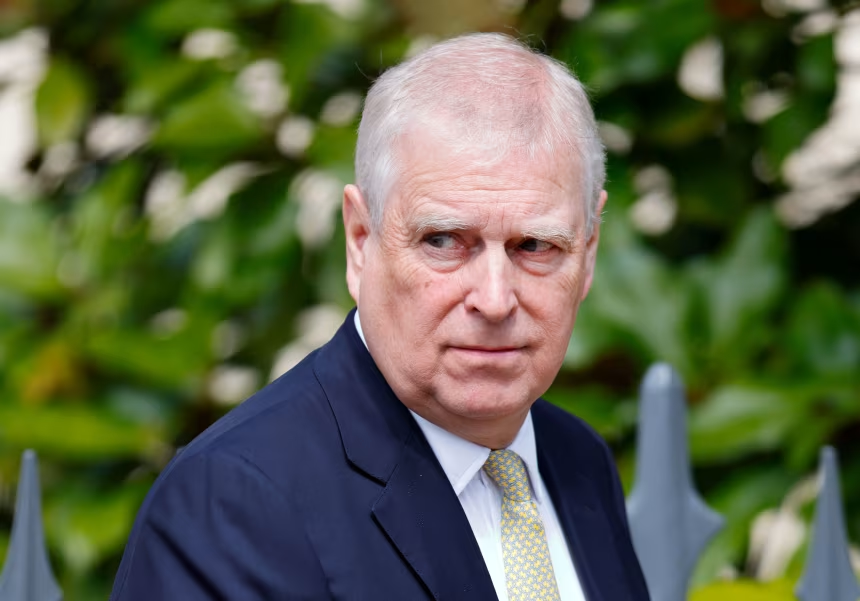
In an extraordinary moment for modern British history, King Charles III has broken his silence to state that “the law must take its course” following the arrest of his younger brother, Andrew Mountbatten-Windsor, on suspicion of misconduct in public office. The arrest, connected to revelations contained within the Jeffrey Epstein files, has sent shockwaves through the monarchy, Westminster, and the broader public, marking the first time in nearly four centuries that a senior member of the royal family has faced criminal arrest.
The Arrest That Shocked the Nation
Andrew Mountbatten-Windsor was arrested by Thames Valley Police on Thursday on his 66th birthday, in connection with allegations that he shared confidential government documents with convicted sex offender Jeffrey Epstein during his tenure as UK trade envoy. Officers confirmed that searches had been carried out at multiple addresses as part of the ongoing investigation, and that the former royal was later released under investigation while enquiries continue.
The arrest came roughly two weeks after an anti-royal campaigning organisation lodged a formal complaint with police, citing newly released Epstein documents as evidence that Andrew may have forwarded sensitive trade papers to the financier during their long association. Metropolitan Police and Thames Valley Police had been reviewing the material for several weeks before action was taken.
King Charles Breaks His Silence
In a carefully worded statement issued through Buckingham Palace, King Charles expressed his “deepest concern” about the unfolding situation while making clear that the legal process must be allowed to proceed without royal interference. He stressed that the Crown would cooperate fully with police and said he would not comment further while the investigation remains active. Observers described the statement as measured and constitutionally appropriate, though unmistakably distancing.
Prince Andrew, King Charles’ younger brother, was arrested on February 19 in Norfolk on suspicion of misconduct in public office over allegations that he shared confidential government documents with Jeffrey Epstein while serving as a UK trade envoy.
The 66-year-old royal was… pic.twitter.com/rTPlGeYr1b
— CNBC-TV18 (@CNBCTV18News) February 20, 2026
What the Epstein Files Revealed
The latest tranche of Epstein documents, released by American courts as part of ongoing civil litigation, contained emails and correspondence that investigators say may point to the sharing of sensitive UK trade information. Andrew served as the government’s special trade envoy between 2001 and 2011, a role that gave him access to commercially sensitive material. Legal experts have stated that forwarding such documents to a private individual could, under British law, amount to misconduct in public office — a serious criminal offence carrying a potential unlimited prison sentence.
Andrew’s Record of Denial
Andrew Mountbatten-Windsor has consistently and categorically denied all wrongdoing connected to Jeffrey Epstein. In a now-infamous BBC Newsnight interview in 2019, he maintained he had no memory of meeting the woman at the centre of the original civil case against him, and stated that his association with Epstein was not something he deeply regretted. He was stripped of his royal titles and military honours in January 2022, and in October 2025 was formally removed from the line of succession.
The former Prince Andrew, now Andrew Mountbatten-Windsor, was arrested Thursday for suspected misconduct in public office after revelations in the Jeffrey Epstein files.
King Charles III's younger brother was arrested on his 66th birthday, about two weeks after an anti-royal… pic.twitter.com/xr76zXZSnG
— CBS News (@CBSNews) February 19, 2026
Political and Parliamentary Reaction
Members of Parliament across all parties responded with cautious restraint in the immediate aftermath of the arrest, with most stressing the importance of allowing police to conduct enquiries without political pressure. The Prime Minister’s official spokesperson confirmed that the government would not be making any comment beyond noting that the justice system operates independently of the executive. Several senior backbenchers on both sides of the House, however, privately described the development as long overdue.
A Precedent Without Modern Parallel
Constitutional historians have noted that this marks the first senior royal arrest since the English Civil War era. The constitutional significance is considerable — not because the Crown is above the law, but because the practical reality of modern monarchy has meant such confrontations with the criminal justice system have been almost entirely absent from British public life. Legal experts have been careful to note that arrest does not indicate guilt, and that the investigation may not result in charges being brought.
The Role of the Crown in Legal Proceedings
A key constitutional question raised by commentators concerns the relationship between the Crown, in whose name all prosecutions are brought, and a member of the royal family facing investigation. Legal experts have confirmed that this creates no formal conflict — prosecutions are brought by the Crown Prosecution Service as an independent body, and the monarch’s personal views carry no legal weight in determining whether charges are pursued. King Charles’s careful language appears designed to reinforce precisely this point.
Former Prince Andrew, the brother of the UK's King Charles III, was released after being arrested Thursday on suspicion of misconduct in public office. https://t.co/8Y7NGWhPMN
— FOX 13 Seattle (@fox13seattle) February 20, 2026
Public Sentiment and Media Coverage
Public reaction in the United Kingdom has been notably mixed. Polling conducted in the days following the arrest suggested that a majority of adults believed it was right for police to pursue the investigation, though a significant minority expressed concern about trial by media and the risk of prejudicing any potential future proceedings. International coverage, particularly in the United States where the Epstein scandal has a deeper political dimension, has been extensive and often more pointed than domestic reporting.
What Comes Next
Thames Valley Police have confirmed that investigations are ongoing but have declined to indicate a timeline for any further developments. The Crown Prosecution Service will ultimately decide whether there is sufficient evidence and public interest to bring charges. That process can take months or longer in complex cases involving historical documents and international witnesses. Andrew Mountbatten-Windsor has not been required to make any public statement and is not obliged to do so under caution while released under investigation.
The Monarchy’s Long-Term Reckoning
Beyond the immediate legal story, commentators have begun to examine what this moment means for the British monarchy as an institution. The Crown has navigated serious controversies before — abdication, divorce, and public scandal — but the arrest of a royal on suspicion of criminal misconduct connected to one of the most notorious international abuse cases in living memory represents a genuinely new kind of challenge. How King Charles manages the balance between family loyalty and constitutional duty may define a significant chapter of his reign.
The investigation into Andrew Mountbatten-Windsor continues, and the full scope of what the Epstein files may yet reveal remains unclear. What is certain is that the events of February 2026 have made the monarchy’s relationship with accountability an unavoidable matter of public debate — and one that a single careful statement from Buckingham Palace is unlikely to resolve on its own.

Written by
Elle Diaz
Elle Diaz is a freelance journalist and fitness model based in the UK. With a background in health, wellness, and popular culture, she covers the stories people are actually talking about — from viral trends and celebrity news to science, lifestyle, and human interest. Elle brings a sharp, relatable voice to every piece she writes.
📷 Follow on Instagram