
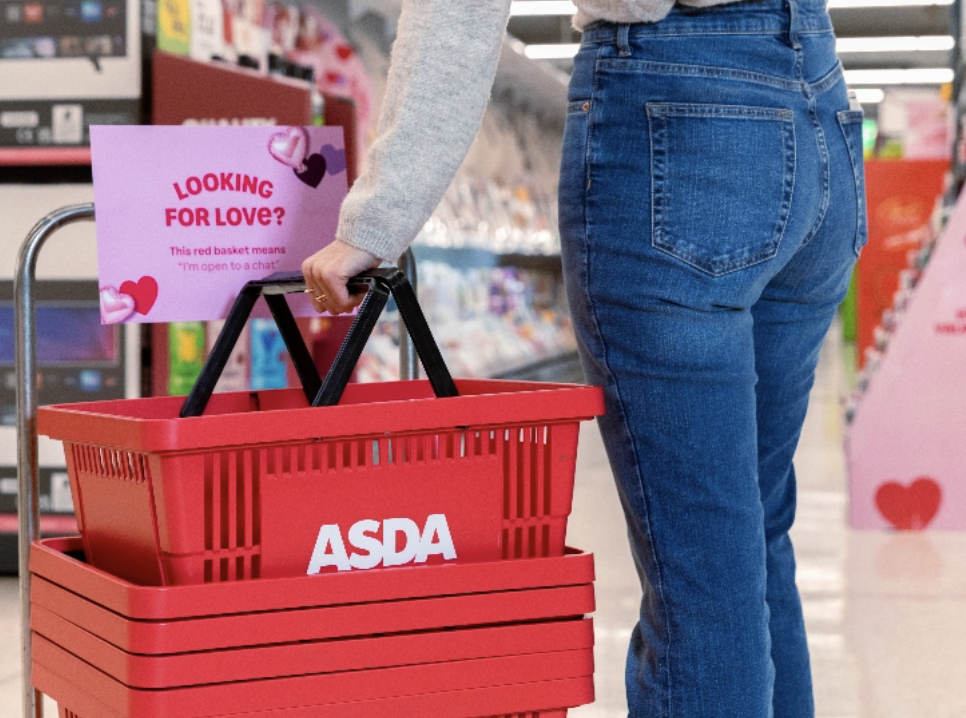
Supermarkets are not typically regarded as romantic venues, but a proposal circulating online about Asda has prompted a genuine national conversation about loneliness, dating, and the surprising places where human connection might be sought and found. The idea — that a specially coloured basket could signal to fellow shoppers that the carrier is single and open to being approached — sounds like something from a satirical piece about the state of modern dating. But the response to it has revealed something real about the appetites and anxieties of a population that is, in significant numbers, struggling to meet people in an increasingly screen-mediated social world.
Where the Idea Came From
The red basket idea did not originate with Asda’s marketing department but appears to have emerged organically from social media, where someone proposed it as a solution to the perceived difficulties of meeting potential partners in everyday life. The concept is simple: shoppers who are single and open to meeting someone would choose a specially coloured basket as a low-stakes signal to others doing the same. The idea spread rapidly, with many people expressing genuine enthusiasm for a method of indicating availability that does not require the vulnerability of a direct approach or the algorithmic filtering of a dating app. Asda’s name became attached to it through the viral momentum of the original suggestion.
Why the Idea Resonated
The enthusiasm for the red basket proposal reveals something about the current state of dating culture in Britain. Dating apps have become the dominant method through which people meet potential partners, but satisfaction with those apps is declining by various measures. The experience of swiping through profiles, navigating matches that go nowhere, and constructing a digital self for evaluation by strangers is one that many people find exhausting and dispiriting. Against that backdrop, the appeal of meeting someone in the mundane context of a weekly shop — where you can observe a real person going about their actual life — is easy to understand. The supermarket as dating venue feels both retro and genuinely appealing.
The Arguments in Favour
Supporters of the red basket concept make several arguments. The supermarket is one of the few remaining public spaces where people of all ages and backgrounds converge regularly, making it a genuinely democratic venue for potential connection. The low-key nature of the signal means that participation requires minimal courage and involves minimal risk of uncomfortable interactions. There is also something to be said for the context: encountering someone while they are choosing vegetables or comparing cereal brands provides authenticity that a profile photo cannot replicate. You are seeing a real person in a real moment of their ordinary life rather than a curated version designed to impress strangers.
The Specifics
It’s believable that “Leave” is the correct response about half of the time among the specific subset of people who rely on Reddit for dating advice https://t.co/3mOpAP0sqe
— Alex Griswold (@HashtagGriswold) March 16, 2026
The Arguments Against
Critics have raised a range of objections, some practical and some rooted in deeper concerns. The most pragmatic is that the scheme would require Asda to implement it, which involves logistical complexity and the risk of significant awkwardness if the initiative does not achieve widespread adoption — a single person with a red basket in a store where nobody else has heard of the scheme is in an uncomfortable position. Others have raised concerns about whether supermarkets should be spaces where single people feel at risk of being approached, noting that not everyone who shops alone is single, and not every single person who shops alone wants to be seen as available.
What Asda Actually Said
Asda has responded with the carefully calibrated engagement that brands have become skilled at deploying when social media hands them an opportunity. The supermarket has not committed to implementing the scheme but has engaged with the conversation in ways that keep its name in the discussion without fully endorsing a proposal that carries genuine potential for criticism. This is the standard playbook for a brand navigating a viral moment that is positive in sentiment but potentially complicated in execution. Whether the conversation translates into any actual change in store policy remains to be seen, though the volume of engagement suggests there is at least an audience for something in this territory.
The Complete Picture

Dating and Public Space in Britain
The red basket debate sits within a broader conversation about the changing nature of dating and social interaction in British life. The privatisation of social life — the retreat from pubs, community spaces, and shared activities into the domestic sphere and the digital world — has made accidental encounters of the kind that used to generate romantic connections increasingly rare. People now meet their partners through apps, existing social networks, or the workplace, and the range of contexts in which serendipitous meetings can occur has narrowed considerably. The fantasy of the supermarket romance is appealing partly because it represents a version of social life that many people feel they have lost access to.
International Precedents for the Idea
The red basket concept is not entirely without precedent in other countries. Various versions of colour-coded or signalling schemes have been proposed and occasionally implemented in retail and social contexts internationally, with varying degrees of success. The broader Scandinavian tradition of designing public spaces to encourage social interaction represents a different approach to the same underlying desire for connection in everyday settings. What is distinctive about the British conversation is the combination of genuine enthusiasm and characteristic self-deprecation — many of those expressing support for the idea do so with an amused awareness of how strange it sounds, which is itself a distinctively British register.
What It Reveals About Modern Loneliness
Perhaps the most significant thing about the Asda red basket moment is what it reveals about loneliness in contemporary Britain. The fact that a proposal for meeting people in a supermarket generated this volume of genuine interest points to a real appetite for connection that existing social infrastructure is not satisfying. The Office for National Statistics has documented significant levels of loneliness across the UK population, and the experience of the pandemic years has compounded existing trends. If supermarket baskets are what it takes to start a conversation about this, then supermarket baskets are doing useful work.
The Significance

The Asda red basket story will most likely not result in any actual change to the experience of shopping at Asda. But it has done something that discussions of loneliness and modern dating rarely manage: it has made the subject feel lighthearted rather than heavy, inviting rather than discouraging. The idea of signalling availability with a coloured basket is, when you think about it, no stranger than constructing a profile that reduces a human being to a photograph and a list of interests. Both are attempts to solve the same problem: the difficulty of finding other people who are open to connection. The basket just feels more honest about it.
The Narrative Continues

Written by
Elle Diaz
Elle Diaz is a freelance journalist and fitness model based in the UK. With a background in health, wellness, and popular culture, she covers the stories people are actually talking about — from viral trends and celebrity news to science, lifestyle, and human interest. Elle brings a sharp, relatable voice to every piece she writes.
📷 Follow on Instagram